The Symphony of Sisterhood: Anita Magsaysay-Ho’s Ode to the Filipina
Published on April 30, 2026 at 10:04 AM by isaiahnoelpulidosalazar
Anita Magsaysay-Ho (1914–2012) stands as a towering pillar of Philippine modern art. Amidst a male-dominated artistic landscape in the mid-20th century, she emerged as the sole female member of the famed "Thirteen Moderns"—a pioneering group of artists who revolutionized the country’s visual arts. Though her marriage led to a peripatetic life spanning Brazil, Canada, Hong Kong, and Japan, her artistic heart never left the sun-drenched archipelagos of the Philippines. She painted entirely from memory, refusing to paint foreign subjects. Through her distinct post-Cubist lens, Magsaysay-Ho elevated the everyday Filipina from a mere subject of pastoral romanticism into a monumental symbol of strength, resilience, and quiet dignity. Her canvases are vibrant choreographies of labor, celebrating women who harvest fruit, catch fish, and weave baskets in a harmonious ballet of communal sisterhood.
A Unique Modernist Idiom
Magsaysay-Ho’s early training under the classical Philippine master Fernando Amorsolo instilled in her a profound appreciation for tropical light and rural life. However, it was her subsequent studies in New York and Michigan that ignited her transition into Modernism. Moving away from Amorsolo’s idyllic, sunlit realism, she developed a signature visual language heavily influenced by Cubism.
Her women are instantly recognizable: marked by angular faces, high cheekbones, elongated necks, and distinctively slanted eyes. Bound by bandanas and dressed in traditional baro't saya (traditional blouses and skirts), these figures are heavily stylized, tightly cropped, and physically intertwined. Magsaysay-Ho did not paint specific portraits; rather, she painted archetypes. The women in her art move with vigorous brushstrokes and rhythmic vitality, their bodies interlocking like puzzle pieces to emphasize a shared, unspoken bond.
Women with Baskets
Nowhere is this rhythmic interplay more beautifully realized than in her celebrated depictions of Women with Baskets. One of her most iconic and recurring motifs, these works showcase women huddled together in the midst of agricultural labor or market preparation.

Picture Source: Untitled (Women with Baskets) via artnet
Three Women with Baskets via Cultural Center of the Philippines
In these compositions, the canvas is typically awash in muted earth tones—warm ochres, deep terracottas, and pleasant shades of pastoral green—punctuated by striking contrasts of light and dark. The women are deeply engrossed in their task, their sturdy arms and nimble fingers handling woven wicker baskets with practiced grace. The baskets themselves are not merely props; Magsaysay-Ho famously noted that baskets were incredibly difficult to paint, presenting a unique challenge of balancing shadow and light through the complex woven texture.
Symbolically, these baskets represent both the bountiful harvest of the earth and the heavy burdens these women shoulder with dignity. With eyes downcast, the women frequently refuse the viewer’s gaze. Instead, they exist entirely within their self-contained universe of silent sisterhood, sharing the weight of their labor without needing to speak a word.
Fish Vendors
Another magnificent facet of Magsaysay-Ho’s oeuvre is her depiction of the bustling Philippine marketplace, masterfully captured in works such as Fish Vendors.
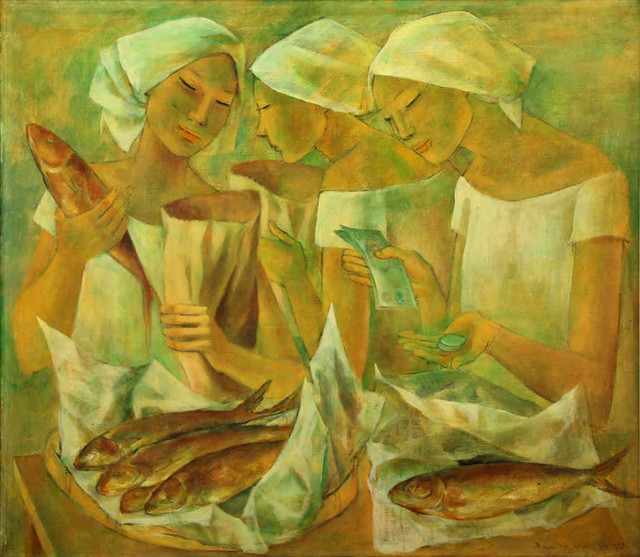
Picture Source: Fish Vendors via Salcedo Auctions
Unlike the serene, pastoral quietude of her field workers, her market scenes hum with kinetic energy and economic agency. In Fish Vendors, the canvas bursts with animated interaction. The women are shown confidently displaying their daily catch. One might hold up a shimmering, silver fish, extolling its freshness, while another sits beside her broad, flat bilao (woven tray).
Magsaysay-Ho captures the intimate,
A Unique Modernist Idiom
Magsaysay-Ho’s early training under the classical Philippine master Fernando Amorsolo instilled in her a profound appreciation for tropical light and rural life. However, it was her subsequent studies in New York and Michigan that ignited her transition into Modernism. Moving away from Amorsolo’s idyllic, sunlit realism, she developed a signature visual language heavily influenced by Cubism.
Her women are instantly recognizable: marked by angular faces, high cheekbones, elongated necks, and distinctively slanted eyes. Bound by bandanas and dressed in traditional baro't saya (traditional blouses and skirts), these figures are heavily stylized, tightly cropped, and physically intertwined. Magsaysay-Ho did not paint specific portraits; rather, she painted archetypes. The women in her art move with vigorous brushstrokes and rhythmic vitality, their bodies interlocking like puzzle pieces to emphasize a shared, unspoken bond.
Women with Baskets
Nowhere is this rhythmic interplay more beautifully realized than in her celebrated depictions of Women with Baskets. One of her most iconic and recurring motifs, these works showcase women huddled together in the midst of agricultural labor or market preparation.
Picture Source: Untitled (Women with Baskets) via artnet
Three Women with Baskets via Cultural Center of the Philippines
In these compositions, the canvas is typically awash in muted earth tones—warm ochres, deep terracottas, and pleasant shades of pastoral green—punctuated by striking contrasts of light and dark. The women are deeply engrossed in their task, their sturdy arms and nimble fingers handling woven wicker baskets with practiced grace. The baskets themselves are not merely props; Magsaysay-Ho famously noted that baskets were incredibly difficult to paint, presenting a unique challenge of balancing shadow and light through the complex woven texture.
Symbolically, these baskets represent both the bountiful harvest of the earth and the heavy burdens these women shoulder with dignity. With eyes downcast, the women frequently refuse the viewer’s gaze. Instead, they exist entirely within their self-contained universe of silent sisterhood, sharing the weight of their labor without needing to speak a word.
Fish Vendors
Another magnificent facet of Magsaysay-Ho’s oeuvre is her depiction of the bustling Philippine marketplace, masterfully captured in works such as Fish Vendors.
Picture Source: Fish Vendors via Salcedo Auctions
Unlike the serene, pastoral quietude of her field workers, her market scenes hum with kinetic energy and economic agency. In Fish Vendors, the canvas bursts with animated interaction. The women are shown confidently displaying their daily catch. One might hold up a shimmering, silver fish, extolling its freshness, while another sits beside her broad, flat bilao (woven tray).
Magsaysay-Ho captures the intimate,